My novel, Kuwaiti Seeker, will appear this spring.
Russia’s Middle East Strategy
Russia has a clearly defined strategy in the Middle East. Their strategy is to appeal to Shia elements of Islam and to utilize Iran as a base of operation. Through Iran they can interact surreptitiously in Yemen through Iran’s interventions there.
Through Iran they work with Shia elements in Iraq, sowing discord where possible.
The strongest recent evidence for their Iranian influence has been their use of Iranian air bases for attacks in Syria, where they have been able to secure Assad’s victory.
In contrast, but to a much weaker degree, the US utilizes Saudi Arabia as its intermediary.
Another Great Idea for the Middle East
Al-Jazeera has reported that the US has floated an idea to solve the Palestinian problem. The Palestinians would have to give up 50% of the West Bank in return for Egypt allowing them a sanctuary in the Sinai.
What an idea! The Palestinians would need to take up residency in an area infested by terrorists of all sorts. And the Egyptian government would be happy to get rid of the responsibility, one they been unable to manage.
Strange Business in the Middle East
A prevalent strategy now extant in the Middle East is governmental attack on news media. We’ve recently commented on Egypt’s prolonged detention of Al-Ajazeera reporter, Mahmoud Hussein.
Now we see the same phenomenon elsewhere. The Lebanese Attorney General filed a lawsuit against the editor of Ad-Diyar, Charles Ayoub, for insulting the King of Saudi Arabia. Not long ago the Attorney General also filed against a local TV personality for stating that the Saudi Arabia Crown Prince should “eat less.” (see https://www.almasdarnews.com/article/lebanese-journalist-faces-prison-time-insulting-saudi-king/).
Ayoub was also arrested in the UAE on similar charges.
There is nothing new in the Middle East about trying to silence the press. But here we have the attacks occurring across national boundaries. Do these episodes reflect strange alliances, for example, Lebanon with Saudi Arabia, or simply fear of the Saudis?
And as this stuff spreads in the Middle East, are we due to see more of it in the US?
Another Trend in the Middle East
The Middle East is the home land of the three great monotheism faiths: Islam, Judaism, and Christianity. Judaism flourishes in little Israel. Islam dominates the region. But Christianity is threatened. Only in Egypt are the Christians (mainly Coptics) protected, and oddly so by the Sisi dictatorship.
Iraq and Syria were formerly home to many Christians. Christians are leaving the area in large numbers.
H.R.390, “Iraq and Syria Genocide Emergency Relief and Accountability Act of 2017” has languished in the ineffectual congress. The urgency of this bill is apparently unrecognized. Without this legislation, or some similar iteration, the trend for the Christian diaspora from the Middle East is unstoppable (see ForeignPolicy.com for more details.)
Egypt, Al-Jazeera, and Mahmoud Hussein
Al-Jazeera journalist Mahmoud Hussein has been held over one year now in an Egyptian prison. Hussein has worked for Al-Jazeera in Cairo since 2010. In December 2016, while on holiday in Cairo, he was arrested and accused of disseminating false news detrimental to the regime. There has been no trial.
Reports indicate there are approximately twenty journalists held in Egyptian prisons.
There are estimates that as many as 60,000 political prisoners are held in Egyptian prisons.
As a country, we have little choice but to support the Al-Sisi government of Egypt. They are our critical allies in the area. We have no way, other than stopping financial aid, to influence their internal behavior. The by-product of this relationship is our tacit support of the Egyptian government’s suppression of political disagreement.
Another Yemen Update
Are things heading toward any resolution in Yemen? No, definitely not.
The Houthis recently tried another missile strike on Saudi Arabia (it failed). It appears clear that Iran is supporting the Houthi side.
The Saudis and UAE continue their bombing campaign against Yemen. The US supplies the Saudis with ground targeting support and air-refueling assistance.
Qatar, according to the Saudis, is a conduit in supplying the Houthis with Iranian munitions. The Qataris deny their involvement. The Gulf Cooperation Council no longer cooperates.
Meanwhile, the Yemeni population continues to suffer with famine and disease.
It seems unlikely the Houthis will be defeated any time soon, so the disaster will continue.
An Interesting Twist to the Prince Salman Story
We’ve already read of the dramatic actions of Saudi Arabia Crown Prince Salman. And now Salman’s friend Prince Bader bin Abdullah bin Mohammed bin Farhan al-Saud has purchased the Da Vinci painting, Salvator Mundi for 450 million dollars. The painting will be displayed in the Arabian Louve in Abu Dhabi.
Notwithstanding the record purchase price, the subject matter in the painting is of striking importance. We must assume Prince Bader understood what he was buying, and also the remarkable statement the painting makes.
The painting depicts Jesus, and the title given to the painting, Salvator Mundi, means Savior of the World. In the painting Jesus raises his right hand in a sign of benediction. His left hand holds a crystal globe signifying the entirety of creation with the heavens contained within a sphere. This representation is a Renaissance era concept of the world.
What does Bader think about all this? Is it merely testament to the fact he has a lot of money? And how does it fit with the Sunni Muslim practice of denying the use of human depictions.
Interesting!
Yemen Update
Most Western news sources ignore Yemen. I haven’t heard about Yemen on CNN for as long as I can recall. BBC mentions Yemen occasionally. Even the Al-Jazeera English site requires a search for Yemen news.
When the Yemeni Houthis fired a ballistic missile at Riyadh, the Saudis blocked entry for even basic food supplies into Yemen airports and harbors. Recently, a grain shipment landed in the port of Saleef on the Red Sea. This relatively small amount of grain will help but will not go far in alleviating the shortage of food. Another shipment has arrived in the port of Hudeida.
According to Al-Jazeera, seven million Yemenis are at immediate risk for famine, making their plight the greatest in recent world history.
Yemen’s problems began to worsen in 2011 when President Saleh was removed from power. He had reigned for 33 years over a country with corruption and minimal resources. At that point, the state of Yemen was bad, but now Saleh’s stabilizing influence is gone. No solutions are in sight.
No One Helps Yemen
For months now Yemen has struggled under the Saudi attacks. A blockade has worsened the already awful conditions with lack of fuel, food, medical supplies and water. The cholera epidemic, which was declining, threatens to get out of control again. Sewerage systems don’t work any longer. Famine spreads across the country. Medical facilities are rendered non-functional.
But nothing has changed, and no help is in sight. There is no political or economic reason to help Yemen.
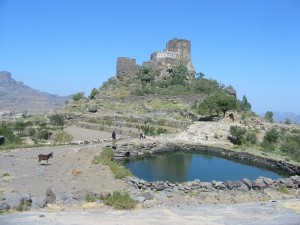
Several years have passed since I last traveled to Yemen. Even then, the signs of economic failure were widespread. The country was a setup for the disaster, and now it has arrived.
Even with its poverty, Yemen was a beautiful country with beautiful people.
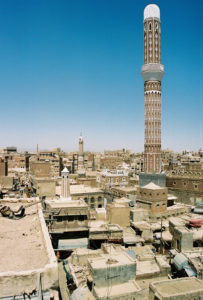
The city of Sanaa as it was.
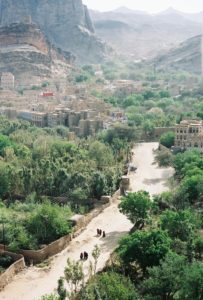
Mountain village

And the mountains themselves.